Wednesday, October 31, 2012

Accounting Principle Changes


Type of Change


What to Do


Accounting Estimate


Prospective (affects the future)


Accounting Principle


Retrospective (affects the past)


Accounting Entity (GAAP only, not IFRS)


Retrospective (Restate)


Easy enough? Let’s pretend….

Your Story #1 – Change in Accounting Principle
Since 2001, you have been using a GAAP accounting method that calculates expense of $10,000 per year. However, in 2005, you decide to change to a different GAAP accounting method that calculates the same expense as $30,000 per year. In the current year, you are showing the income statements from 2004 and 2005. With this change, what amount do you report in the earliest retained earnings figure being shown?

Changes in accounting principles are handled retrospectively, meaning the expense for each year should be changed to $30,000. Since 2001, 2002, and 2003 are not reported, the accumulated change from these 3 years will need to be reported as a change in the earliest retained earnings.
($30,000 - $10,000)*3 = $60,000.

$60,000 will be the amount that you will report in the beginning retained earnings for 2004.

Your Story #2 – Change in Depreciation Method (Estimate)
You bought a store for $100,000 in Year 2001. You expected it to last for 10 years, and you believed that there is a salvage value of $20,000. During Year 2004, you realize that the total life of the store is actually 6 years, and there is no salvage value. Assume that you use straight-line. What is the net book value of your store on the December 31, 2004 balance sheet?

A change in depreciation method is a change in accounting principle that is inseparable from a change in estimate; thus, this must be handled prospectively.

1) Calculate the accumulated depreciation before the change took place.
([$100,000 - $20,000]/10 years)*3 years = $24,000

2) Use the new estimate method to calculate the deprecation going forward:
6 years (new estimate) – 3 years passed = 3 years remaining
$100,000 - $24,000 = $76,000 (book value at the beginning of 2004)
$76,000/3 = $25,333 (depreciation expense for 2004)
$76,000 - $24,000 (accumulated depreciation) = $52,000 (net book value)

The net book value at the end of 2004 is $52,000.

Other Notes:
- 2 ways to present changes in accounting principle
  1. 1 year financial statement presentation: adjust beginning Retained Earnings number with the cumulative change
  2. 2 years financial statement presentation: adjust the prior year opening balance for retained earnings. Use new method number for current year.
- Change in accounting entity – pretend that you’ve always had it and just restate your financial statements

Investment Keyword - VC

 Venture Capital (noun):
  • Funds given to early stage, high potential, high risk, startup companies with no access to capital markets
  • High risk for the investor, but potential for above-average returns
Venture capital fund makes money by owning equity in the companies that it invests in.

“In exchange for the high risk that venture capital investors take on in investing in smaller companies, venture capitalists usually get significant control over company decisions and also a significant portion of the company's ownership (and consequently value).”

Reference, read more: http://www.investopedia.com/terms/v/venturecapital.asp#ixzz2Ap9hIX93

Tuesday, October 30, 2012

Extraordinary Items

Ultimate definition of being “out of the ordinary” - Material, Unusual, AND Infrequent!

All of these qualities must be considered based on the context of the location and operations of your company though! If you are located in a place that will constantly have earthquakes, then an earthquake will not be considered an extraordinary item.

If something material happens that is either unusual OR infrequent, then it is considered part of your income/loss under continuing operation – non-operating item, before tax.

Reporting an extraordinary item only impacts the placement of the gains and losses, not the overall net income. Keep in mind that numbers are not changed, but the position of the item reported on the income statement does change. When it is not an extraordinary item, it is listed under non-operating, before tax. When it is an extraordinary item, the item is net of tax and shown at the bottom of the income statement.
*IFRS does not allow the reporting of extraordinary items on the income statement or notes to financial statements.

Examples of Extraordinary Items:
  • abandonment/damage due to infrequent natural disaster
  • "theft" by government
  • Illegal products due to new laws

Report a Discontinued Operation

In order of a component of a company to be reported in discontinued operations, it has to either be (1) disposed or (2) classified as “held for sale.”

Steps to calculate a discontinued operation:
  1. Impairment loss (BV – FV)
  2. Gain/loss from operations (Held for sale – annual; Disposed – up to the sale)
  3. Gain/loss from sale of discontinued operation
  4. Net of tax 
Let’s Pretend – Your Story
During 2011, you decide to sell a component of your company, “Bees,” that was losing $100 per month. Its carrying value is $1000, and the fair value less costs to sell is $500. “Bees” sold for $800 on May 31, 2012. “Bees” is still losing $100 per month. Tax rate is 30% for both years. How do you record the disposal for 2011 and 2012?

Year 2011: 
  1. Impairment loss = $1000 - $500 = $500
  2. Gain/loss from operations = $100*12 = $1200
  3. Tax from discontinued operations = ($500 + $1200)*30% = $510
  4. Total loss from discontinued operations = ($500 + $1200) - $510 = $1190
Year 2012:
  1. Gain/loss from operation: $100*5 = ($500)
  2. Gain/loss from sale = $800 - $500 = $300
  3. Total loss from discontinued operations (net of tax) = [$300 – ($500)]*(1 – 70%) = $140
Other things to remember:
  • Whether or not the sale of an asset qualifies as a discontinued operation fully depends on the internal reporting of the company. If the cash flows and operating results are clearly distinguished, then it must be reported on the income statement as a discontinued operation.
  • If comparative statements are presented and an item is classified a discontinued operation in the current fiscal year, prior year income statement will be rearranged to separate out the operations from the discontinued asset for comparison purposes (net income does not change).

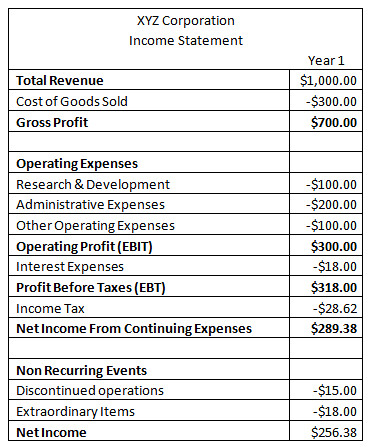
Elements of the Income Statement and RE

Income Statement
1) Income from Continuing Operations (before tax & after tax): includes operating, non-operating, & income tax
2) Income from Discontinued Operations (after tax)
3) Extraordinary Items (after tax)

Statement of Retained Earnings
4) Cumulative effect of Change in Accounting Principle (after tax)

We need the income statement to tell us (1) how the company's funds are use and (2) what money is actually coming into the company because of how we spend our funds. It helps us determine the profitability, performance, and the value of the company.

Image taken from: http://thexorb.com/Finance/Income/IncomeStatement.aspx